
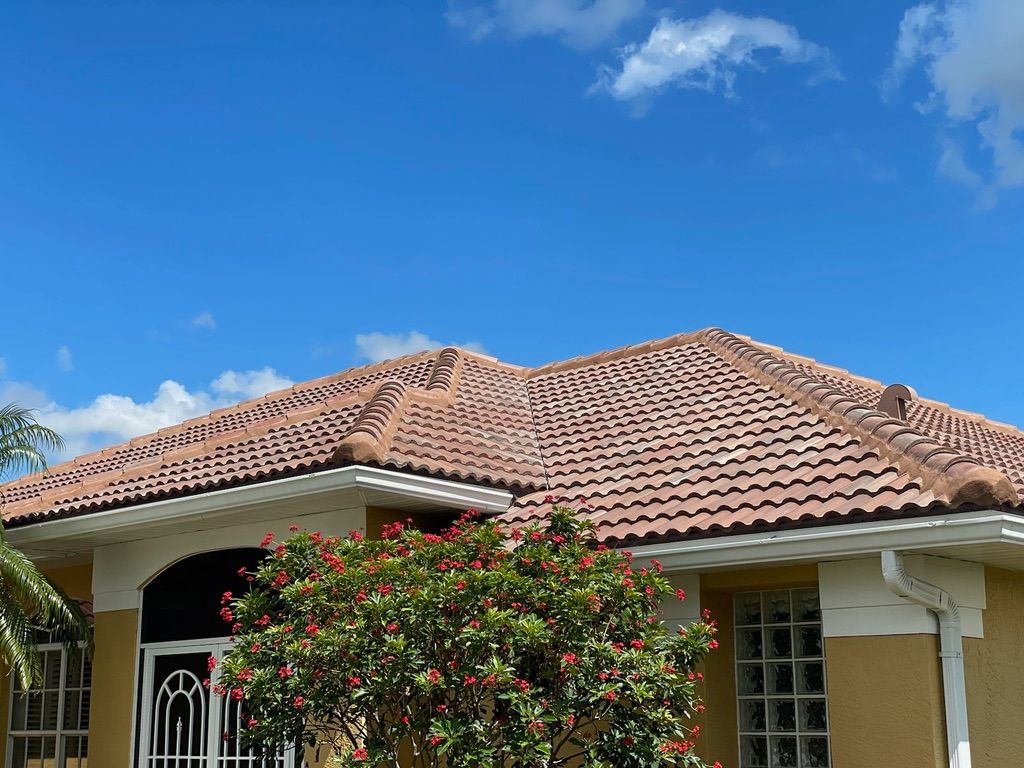
A tile roof can look as good as the day it went on and still be close to the end of its working life. That’s one of the quirks of roofing in Southwest Florida, which is why the lifespan figures you find online don’t hold up here. So how long does a roof last in Florida? Asphalt shingles typically give you 15 to 20 years. Metal lasts 40 to 70 years. Tile can last 50 years or more, as long as you replace the underlayment along the way.
For many homeowners, the question arrives in the mail before it shows up on the ceiling. An insurance renewal may require a roof inspection, or a carrier may flag a roof that has passed the 15-year mark. Other homeowners are still trying to figure out how much Hurricane Ian or Milton took out of a roof that seemed fine afterward. And some are weighing tile against metal for a replacement and want numbers that fit the Gulf Coast.
Florida Roof Lifespan by Material
National lifespan figures assume moderate weather. Florida has strong sun almost every day of the year, months of high humidity, and a seemingly endless hurricane season. For most materials, the realistic range here is 25% to 40% shorter than the national average.
| Roof Material | National Average | Realistic Florida Lifespan | Florida Considerations |
| 3-Tab Asphalt Shingles | 20–25 years | 10–15 years | Lightweight tabs; first to fail in high wind |
| Architectural Shingles | 25–30 years | 15–20 years | The standard shingle choice; get an assessment around year 15 |
| Premium/Impact-Resistant Shingles | 30–50 years | 20–25 years | Good upgrade where HOAs limit tile or metal |
| Clay Tile | 50–100+ years | 50+ years (underlayment: 15–20) | Tiles outlast the underlayment beneath them |
| Concrete Tile | 50+ years | 40–60 years (underlayment: 15–20) | Prone to color fading; same underlayment issue |
| Metal (Standing Seam) | 40–70 years | 40–70 years | Closest match to national numbers; aluminum best near the coast |
| Flat (TPO, EPDM, Modified Bitumen) | 15–30 years | 10–20 years | Drainage and seam integrity decide lifespan |
Asphalt Shingles: 3-Tab
The traditional 3-tab shingle is the most budget-friendly roof for a Florida home, but it’s also the least durable. It’s rated for 20 to 25 years nationally, but 10 to 15 is closer to reality here. A single flat layer of asphalt has little mass to withstand year-round sun, so it ages quickly. Humidity adds algae and trapped moisture to the mix. In a hurricane, those lightweight tabs are among the first things to lift and tear off. It’s the most commonly replaced roof type in Southwest Florida, and most homeowners trade up when the time comes.
Architectural (Dimensional) Shingles
Architectural shingles are built from two or more laminated layers. That gives them more weight, a dimensional look, and a much stronger grip in high winds. They’re the default for most Florida homeowners who want shingle roofing. Plan on 15 to 20 years here, compared with 25 to 30 nationally. Product quality makes a real difference. GAF’s Timberline HDZ line, for example, carries a wind rating of up to 130 mph when installed to the manufacturer’s specifications. Around year 15, schedule a professional assessment, even if the roof still looks fine.
Premium and Impact-Resistant Shingles
Premium and impact-resistant shingles use tougher asphalt blends and reinforced backing. They resist hail and wind-blown debris better than standard shingles. In Florida, they typically last 20 to 25 years, an improvement over architectural shingles, but they still wear down from the same sun and humidity. They’re a smart middle ground if you live in a community where the HOA doesn’t allow tile or metal and you want more than the basic option.
Tile Roofing: Clay and Concrete
Tile is everywhere in Southwest Florida, and many HOAs require it. Clay tile can last 50 to 100 years or longer. Concrete tile usually lasts 40 to 60 years in Florida and tends to fade more over time. Because tile is so heavy, it naturally resists wind uplift. Its weak spot is breakage: a falling branch, storm debris, or a misplaced step can crack a tile.
Most homeowners don’t know this next part. The tiles don’t keep water out. That job belongs to the underlayment, the waterproof layer beneath them. That underlayment typically lasts 15 to 20 years in Florida’s heat and humidity. When a tile roof “needs replacing,” the tiles themselves are usually fine. The underlayment has failed. In many cases, a contractor can remove the tiles, replace the underlayment, and reinstall the original tiles for far less than a full new tile roofing system.
Metal Roofing
Metal is the one material whose Florida lifespan roughly matches the national figure: 40 to 70 years. Standing seam systems perform best because their fasteners are hidden beneath raised seams, out of the sun and rain. Properly installed systems can be rated for winds in the 140 to 180 mph range. Near the Gulf or on a barrier island, aluminum is usually the better choice than steel because it naturally resists salt-air corrosion. A metal roof also bounces much of the sun’s heat back into the sky, which takes some of the load off your air conditioner during Florida’s long summers.
Metal roofing carries the highest price tag at installation. Spread across 40-plus years, though, the cost per year often comes out lower than shingles, which you might replace two or three times over the same span.
Flat Roofing (TPO, EPDM, and Modified Bitumen)
Low-slope roofs are common on commercial buildings, lanais, and some modern home designs. There are three main types:
- TPO: a white, heat-reflective single-ply membrane
- EPDM: a durable synthetic rubber membrane
- Modified bitumen: a layered asphalt-based system
Nationally, these last 15 to 30 years. In Florida, 10 to 20 is more typical. Two things shorten their life here. Daily heat makes the membrane expand and contract, which stresses the seams. And standing water, or “ponding,” after summer storms breaks down the membrane faster. Good drainage is the biggest factor in how long flat roofing lasts in this climate.
Why Florida Roofs Don’t Last as Long as the Warranty
A manufacturer’s warranty has to cover homes in every state, so it’s built around middle-of-the-road weather. Southwest Florida gets the extremes. Here’s what does most of the damage.
UV and Heat Exposure
The sun here doesn’t take a season off. Over time, UV radiation makes asphalt brittle, cooks the sealant strips that hold shingles down, and hardens the caulk around vents and skylights. Heat adds a second kind of wear. A roof can bake in the midday sun, then cool quickly when an afternoon thunderstorm rolls through. Each swing flexes the roofing materials a little. After thousands of cycles, fasteners loosen and seams start to separate.
Humidity and Moisture
The dark streaks on so many Florida roofs are usually algae, and they’re more than a cosmetic problem. Algae holds moisture against the roof surface, which speeds up wear. Humidity also gets trapped under tiles and inside poorly ventilated attics. That’s the main reason tile underlayment rots out decades before the tiles do.
Hurricanes and Severe Weather
A single major hurricane can take years off a roof’s remaining life, even when the roof looks untouched afterward. Sustained wind can loosen fasteners, nudge tiles out of position, and break the seal on shingle edges. That damage often stays hidden until the next tropical downpour finds its way inside. If your roof came through Ian, Milton, or any named storm without a professional inspection, it’s worth getting one now.
Salt Air in Coastal Communities
In Venice, Boca Grande, Longboat Key, Cape Coral, and other waterfront areas, salt air corrodes metal flashing, fasteners, and exposed-fastener panels. It also wears down some sealants faster. Aluminum and stainless steel components last much longer than galvanized steel in salt-air environments. That’s worth asking about before you sign a replacement contract.
The Florida Insurance Factor
For many Florida homeowners, the timing of a new roof installation matters as much as the roof’s condition.
Under Florida Statute 627.7011, an insurer can’t refuse to write or renew a homeowners policy just because the roof is under 15 years old. Once your roof hits 15 years old, the rules change. Your insurer can require a replacement as a condition of coverage, but it must first let you get an inspection by an authorized inspector at your own expense. If that inspection shows at least five years of useful life remaining, the insurer can’t refuse coverage based on roof age alone.
There’s an important catch. The law only blocks refusals based solely on age. Insurers can still decline or nonrenew a policy for other underwriting reasons, and premiums on older roofs can climb steeply. In practice, a 17-year-old shingle roof that still keeps the rain out may still need replacing to keep coverage affordable.
The building code matters too. Florida used to require a full roof replacement whenever more than 25% of a roof needed repair. That rule changed in 2022. Now, if your roof was built or replaced under the 2007 Florida Building Code (FBC) or later, generally roofs installed after March 2009, only the repaired section has to meet current code. The 8th Edition of the FBC, effective December 31, 2023, carries this exception forward. Roofs older than that may still trigger a full replacement after significant storm damage.
Signs Your Florida Roof Is Near the End of Its Life
Start with what you can check yourself. From the yard, the attic, or a ladder at the gutter line, watch for:
- Shingles that are missing, cracked, or curling at the edges
- Tiles that have slipped, shifted, or broken
- Gritty granules washing out of downspouts
- Large patches of dark algae staining
- Ceiling stains, bubbling paint near the roofline, or a musty attic
- A roofline that dips or sags
- A roof that’s already within the Florida lifespan range for its material
Tile roofs are the exception to the do-it-yourself check. Underlayment failure happens under the tiles, out of sight, so a tile roof can look perfect from the street while its waterproofing is already breaking down. A professional inspection is the only reliable way to know.
Not every warning sign means you need a new roof. A few cracked tiles, a lifted flashing, or a single leak on an otherwise healthy 10-year-old roof is usually a job for professional roof repair. Replacement makes more sense in three situations:
- The roof is at or beyond its Florida lifespan
- Problems are showing up in several areas at once
- Your insurer is pushing back on renewal
How to Extend Your Roof’s Life in Florida
A Florida roof works harder than most, but good habits can buy it real time. Start at the top of this list, where the payoff is biggest:
- Get eyes on the roof every year. An annual professional inspection, plus one after any named storm, catches problems while they’re still small and inexpensive.
- Stop leaks before they spread. In this humidity, water that gets past the roof surface moves into the underlayment and decking fast.
- Keep gutters and roof valleys flowing so summer downpours drain off instead of backing up under the roof edges.
- Cut back palms and overhanging limbs. Fronds rub against the roof surface, and loose limbs become debris in a storm.
- Check your attic ventilation. Heat and moisture trapped in the attic wear a roof down from underneath.
- Deal with algae early, using a cleaning method that’s safe for roofing. High-pressure washing can strip shingle granules.
- Plan for quality at replacement time. Product choice and installation to Florida code set the ceiling on how long your next roof can last.
For a deeper look at maintenance, here’s our guide on how to extend the life of your roof.
Find Out How Much Life Your Roof Has Left
Whether your roof has five good years left or fifteen depends on details only an inspection can reveal. What shape is the underlayment in? How did your roof handle the last storm? What will your insurer want to see? Anthony C. Leonard Roofing has been answering those questions for Southwest Florida homeowners since 1980. The third-generation, family-owned company installs tile, shingle, metal, and flat roofing systems. Their team can tell you plainly whether your roof needs a repair, a replacement, or just a clean bill of health for your insurance company.
Every project is backed by a leak-free guarantee and a 20-year workmanship warranty, with $0 deposit required. Anthony C. Leonard Roofing serves Sarasota, Bradenton, Venice, Fort Myers, Tampa, and communities throughout Southwest Florida.
Request your free estimate today, or call (941) 474-3533 to schedule an inspection.
Sources:
The Florida Senate. 2025 Florida Statutes, Section 627.7011: Homeowners’ Policies; Offer of Replacement Cost Coverage and Law and Ordinance Coverage. https://flsenate.gov/Laws/Statutes/2025/627.7011
Jimerson Birr. Recent Changes to Florida’s 25% Roof Replacement Rule. https://www.jimersonfirm.com/blog/2023/01/recent-changes-floridas-25-roof-replacement-rule
Florida Roofing and Sheet Metal Contractors Association. Current and Coming Changes to the “25% Rule.” https://www.floridaroof.com/news/florida-roofing-magazine/12
Share this post
Get Your Free Estimate!
Call now for expert roofing services.


